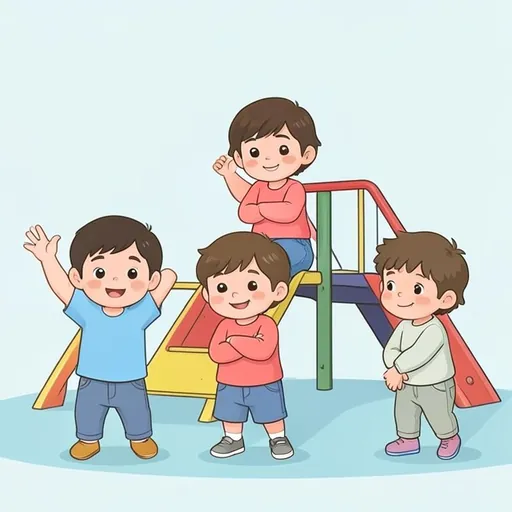
What Does Their Body Say? Reading Body Language
- Game
- K–3
- 1 page · 8 min
Ten pictured moments where posture, gestures, or movement send a message: crossed arms and looking down, a body turned toward the speaker, a body turned away, open arms, hands over ears, a low head and slumped shoulders, leaning in and nodding, stomping with tight fists, a high wave, and a shrug with palms up. Show the picture and ask "What is their body saying?" The card gives a possible meaning, so remind the student that body language is a clue and not proof, and have them say what they could do next. Score each as independent, cued, or modeled in your own data.
Talk about it
What Does Their Body Say? Reading Body Language
10 cards — tap to deal
How to run it
Deal one card at a time. The student looks at the picture and says the sentence on the card before you move on. You judge the production yourself; the cards advance either way. Work through the set once for a baseline, then return to the cards that were hard. Keep your own data: mark independent, cued, or modeled trials in your session notes. If the student is tired, do a shorter set instead of rushing the last cards.
Cueing ladder
Start at the top. Add support one step at a time.
- IndependentPresent the situation and wait 5 seconds of quiet before helping.Log as correct
- HintPoint to the part of the picture that matters, or ask what the other person might think.Log as cued
- Two choicesGive two possible lines and let the student pick one and say it.Log as cued
- ModelModel a full line the student can repeat, then try the next card.Log as cued
Adjust it
Act out the situation with puppets or role-play and offer the first few words of a line.
Ask the student to give a reason for the line they chose, or to try a second option.
Matching IEP goal
Given a pictured social situation, Student will choose or produce an expected comment or request in 8 of 10 opportunities across 3 consecutive sessions, given no more than an indirect cue.
Send it home through the parent portal →About this activity
What Does Their Body Say? Reading Body Language is a speaking cards board for kindergarten through grade 3 students. Ten pictured moments where posture, gestures, or movement send a message: crossed arms and looking down, a body turned toward the speaker, a body turned away, open arms, hands over ears, a low head and slumped shoulders, leaning in and nodding, stomping with tight fists, a high wave, and a shrug with palms up. Show the picture and ask "What is their body saying?" The card gives a possible meaning, so remind the student that body language is a clue and not proof, and have them say what they could do next. Score each as independent, cued, or modeled in your own data. It is a sentence-level board for use in a short therapy block or a station; you score the responses yourself.
What to listen for
Watch for the student pointing to a specific part of the body, such as arms, head, or hands, as the clue. Remind them that body language is a hint and not proof, and note whether they say what they could do next. Write down the cue level that made the next try work so you can fade it next session. Examples on this board include Her arms are crossed and she is looking down. She may be upset, He is facing the teacher and sitting still. He is listening, She turned her body away. She may not want to talk right now, His arms are open and he is smiling. He is happy to see you, and Her hands are over her ears. The room may be too loud.
Carrying it home
Pick two or three items from the board and use them in a real routine at home or in class the same day. An adult can show the picture, wait, and then model the word or sentence if it helps. Keep practice short, one or two minutes is enough, and use the board as practice and not as a test; your SLP will interpret how it went.
What's in this activity
- Her arms are crossed and she is looking down. She may be upset.
- He is facing the teacher and sitting still. He is listening.
- She turned her body away. She may not want to talk right now.
- His arms are open and he is smiling. He is happy to see you.
- Her hands are over her ears. The room may be too loud.
- His head is down and his shoulders are low. He may feel sad or tired.
- She is leaning in and nodding. She is interested.
- He is stomping and his fists are tight. He may be angry.
- She is waving her arm high. She wants your attention.
- He is shrugging with his palms up. He may not know.
Questions
- Who is this for?
- This board is for kindergarten through grade 3 students working on the skill in the description, including Her arms are crossed and she is looking down. She may be upset, He is facing the teacher and sitting still. He is listening, She turned her body away. She may not want to talk right now, His arms are open and he is smiling. He is happy to see you, and Her hands are over her ears. The room may be too loud.
- Is it free?
- Yes. It plays free in the browser with no login. An account adds session data, goal scoring, and assignment to a student.
- Can I change the items?
- Yes. Copy the activity to your library or rebuild the list in Activity Studio with the same template. Keep the same target and grade band so the pictures and wording still fit.
Use this board with your caseload
With a free account, every correct, cued and incorrect mark is saved to the student and scored against their IEP goal, with the data written up for you. Assign it as home practice through the parent portal.
Track progress freeFree for SLPs. No card, no trial clock.