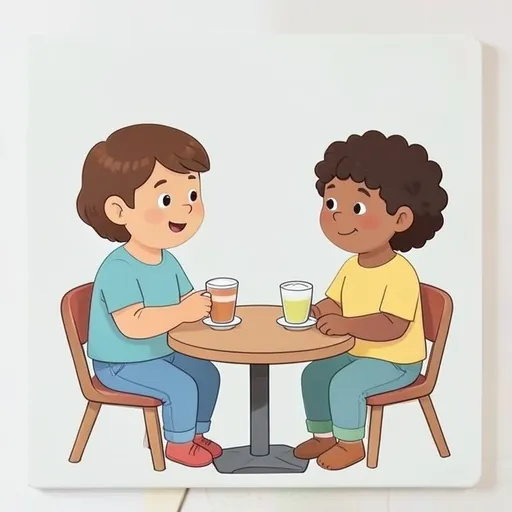
Café Conversations: You Choose What to Say
- Game
- 3–8
- 9 pages · 10 min
9 everyday conversations at a café and at school, with choices about what to say and do. Stuttering is welcome: there is no fluency score. Built for grades 3–8, it works in pull-out, push-in, or teletherapy, with 9 screens, in about 10 minutes. Skill tags on this board: self-advocacy, conversation. Plays in the browser with no login; add students to score trials against IEP goals.
Quiz
Café Conversations: You Choose What to Say
You want a hot chocolate. What could you say?
Tap your answer.
Session summary (SOAP)
Stays on this screen. Nothing is saved or sent.
Mark a card Correct, Correct with cue or Incorrect and the summary writes itself here.
How to run it
Read each conversation aloud or let the student read it. After choosing, have the student say the line the way they would really say it, and accept any fluency. Talk about other good answers too; the choice marked right is one good option, not the only one. The last question is a reminder that the student decides what to share.
Cueing ladder
Start at the top. Add support one step at a time.
- IndependentSet up the situation and wait for the student to respond on their own.Log as correct
- Nonverbal cueUse a look, a gesture or a point to the visual cue card.Log as cued
- Indirect promptAsk 'What could you say now?' or 'How do you think they feel?'Log as cued
- ModelShow what to say or do, then run the moment again so the student can try it.Log as cued
Adjust it
Give a script or two choices of what to say, and practise with you before a peer.
Role-play with a new partner, or add a twist the student has not planned for.
Matching IEP goal
Given school and community scenarios, Student will state a need or a plan clearly to the right person in 4 of 5 opportunities across 3 consecutive sessions, given no more than an indirect prompt.
Send it home through the parent portal →About this activity
Nine everyday conversations: ordering a hot chocolate, being interrupted in a group, someone finishing your sentence, a friend asking why you repeat sounds, being told to slow down. The student chooses what to say or do. Stuttering is welcome throughout: nothing is scored on how anyone talks, and the answers are about speaking up, sharing your ideas and being a good listener.
What to listen for
Notice the questions about other people's reactions (finishing words, being told to slow down). They can bring up real feelings, so leave room to talk. Watch whether the student picks avoiding answers like leaving the line, and talk about what makes speaking up feel possible.
Carrying it home
At a café or store, let your child order if they want to, and wait while they talk. If someone finishes their words, talk later about what your child would like to say next time.
What's in this activity
- You want a hot chocolate. What could you say?
- Can I have a hot chocolate please
- Point and say nothing
- Leave the line
- Someone finishes your sentence for you. What could you say?
- Stop talking forever
- Thanks but let me finish
- Walk away
- A friend asks why you sometimes repeat sounds. What could you say?
- Make up a story
- Ignore the question
- I stutter sometimes. It is ok
- You are interrupted in a group. What could you do?
- Say I was not finished yet
- Stop talking for the day
- Talk louder than everyone
- The barista asks you to repeat your order. What could you do?
- Give up and leave
- Say it again or point to the menu
- Get angry
- Someone says just relax and talk slower. What could you say?
- Never talk to them again
- Cry
- Thanks but I am ok talking my way
- You have an idea in class. What could you do?
- Raise your hand and share it
- Keep it to yourself always
- Shout it out
- A new student stutters. How could you be a good listener?
- Finish their words
- Wait and let them finish
- Laugh
- Who decides what you share about your stutter?
- your friends do
- strangers do
- you do
Questions
- Does this practise fluency techniques?
- No. It practises communicating and self-advocacy. Fluency is never scored.
- Can a student who does not stutter use it?
- Yes. The good-listener questions are for everyone.
Use this board with your caseload
With a free account, every correct, cued and incorrect mark is saved to the student and scored against their IEP goal, with the data written up for you. Assign it as home practice through the parent portal.
Track progress freeFree for SLPs. No card, no trial clock.