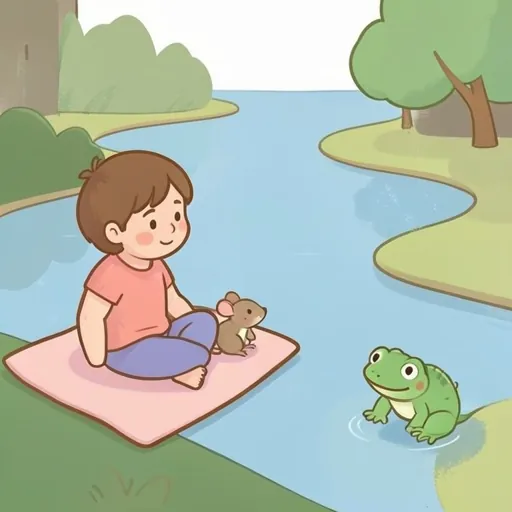
Story Time: A Day at the Pond
- Game
- PreK–2
- 9 pages · 10 min
A short read-aloud story in three parts about a mouse and a frog, with 9 questions on opposites, concepts and story details. Built for grades PreK–2, it works in pull-out, push-in, or teletherapy, with 9 screens, in about 10 minutes. Skill tags on this board: basic concepts, opposites, listening comprehension. Plays in the browser with no login; add students to score trials against IEP goals.
Quiz
Story Time: A Day at the Pond
This device has no voice — read the passage aloud to the student.
Mo the mouse lived by a big pond. One morning Mo woke up early and the sky was dark. He ate a small breakfast of seeds and ran outside. The water in the pond was cold, so Mo did not swim. He sat on a warm rock instead.
Was the sky light or dark when Mo woke up?
Tap your answer.
Session summary (SOAP)
Stays on this screen. Nothing is saved or sent.
Mark a card Correct, Correct with cue or Incorrect and the summary writes itself here.
How to run it
Play each part and let the student listen without the words. Replay a part if needed before answering. After each question, say the opposite pair aloud together ('empty, full') and use your hands to show it. At the end, ask the student to retell the day from morning to night.
Cueing ladder
Start at the top. Add support one step at a time.
- IndependentPresent the item and wait 5 seconds of quiet before helping.Log as correct
- HintReread the key sentence, or point back to the clue in the text or picture.Log as cued
- Two choicesOffer two answers, the right one not always second.Log as cued
- ModelThink aloud: say how you worked it out, then the student says the answer and why.Log as cued
Adjust it
Read it aloud to the student and offer two choices from the start.
Ask the student to say which words gave them the clue, not just the answer.
Matching IEP goal
Given short texts or spoken prompts, Student will show understanding of basic concept words in 8 of 10 opportunities across 3 consecutive sessions, given no more than an indirect cue.
Send it home through the parent portal →About this activity
A three-part story read aloud by the board, about Mo the mouse and Tad the frog spending a day by a pond. The story is built around opposites and concepts: light and dark, big and small, fast and slow, up and down, empty and full. After each part the student answers three questions, nine in all, and the words stay hidden so it is a listening task.
What to listen for
Notice whether errors cluster on one pair of opposites or on the why question in the first part. A student who answers 'big' for the small breakfast may have heard 'big pond' and held on to it, which is a listening-memory slip more than a concept gap.
Carrying it home
Read any picture book together and pause on opposites: 'The cup is empty. Now it is...?' Let your child finish the sentence, and act out up and down, fast and slow, on the way to the park.
What's in this activity
- Was the sky light or dark when Mo woke up?
- dark
- light
- pink
- Was Mo's breakfast big or small?
- big
- small
- empty
- Why did Mo sit on a rock instead of swimming?
- he was hungry
- the rock was wet
- the water was cold
- Who was fast?
- Tad the frog
- Mo the mouse
- the berry bush
- Mo went up the hill. Which way did Tad go?
- up
- down
- inside
- Where did Mo end up when he slid?
- at the top
- in the pond
- at the bottom
- What did Mo carry to the bush?
- an empty basket
- a full basket
- a warm rock
- What was the basket like when he came back?
- empty
- full
- cold
- What did Mo do at the end of the day?
- ate breakfast
- ran a race
- went to sleep
Questions
- Is this a reading activity?
- No. The board reads the story aloud and hides the text, so the student works from listening.
- Why opposites?
- Concept pairs like empty and full come up in classroom directions every day, and a story gives them a reason to matter.
Use this board with your caseload
With a free account, every correct, cued and incorrect mark is saved to the student and scored against their IEP goal, with the data written up for you. Assign it as home practice through the parent portal.
Track progress freeFree for SLPs. No card, no trial clock.