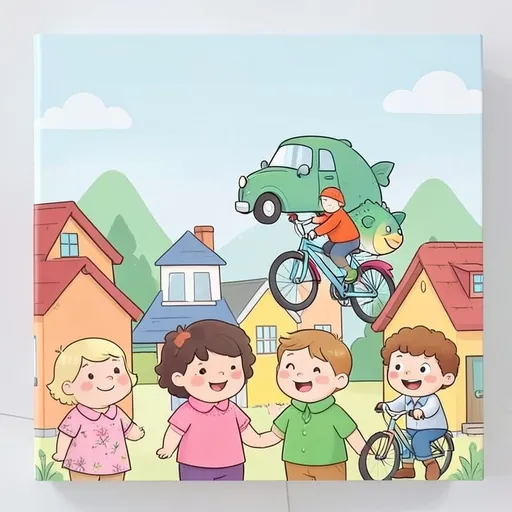
What's Silly? Around Town
- Game
- 2–4
- 10 pages · 10 min
10 silly scenes around town: the bakery, the beach, the bus stop and more. What does not make sense? Built for grades 2–4, it works in pull-out, push-in, or teletherapy, with 10 screens, in about 10 minutes. Skill tags on this board: inferencing, verbal reasoning, absurdities. Plays in the browser with no login; add students to score trials against IEP goals.
Quiz
What's Silly? Around Town

The firefighters rush to the fire on tricycles. What is silly?
Tap your answer.
Session summary (SOAP)
Stays on this screen. Nothing is saved or sent.
Mark a card Correct, Correct with cue or Incorrect and the summary writes itself here.
How to run it
Read each scene and ask who or what the scene is about before choosing. After each answer, ask the student to explain what really happens at that place, such as how the barber cuts hair. Use the scenes to talk about community helpers and places the student visits.
Cueing ladder
Start at the top. Add support one step at a time.
- IndependentPresent the item and wait 5 seconds of quiet before helping.Log as correct
- HintReread the key sentence, or point back to the clue in the text or picture.Log as cued
- Two choicesOffer two answers, the right one not always second.Log as cued
- ModelThink aloud: say how you worked it out, then the student says the answer and why.Log as cued
Adjust it
Read it aloud to the student and offer two choices from the start.
Ask the student to say which words gave them the clue, not just the answer.
Matching IEP goal
Given short texts or spoken prompts, Student will make an inference and say which clue they used in 8 of 10 opportunities across 3 consecutive sessions, given no more than an indirect cue.
Send it home through the parent portal →About this activity
Ten silly scenes around town, such as firefighters rushing to a fire on tricycles, groceries paid for with a leaf, a purple traffic light, a goldfish on a leash and a bakery that sells shoes and socks. These scenes ask the student to know how places in the community work, so they suit second to fourth grade.
What to listen for
Notice whether the student's errors come from not knowing the place (the student who has never seen a barber) or from not spotting the problem. The first needs background knowledge; the second needs more practice holding the scene in mind and checking it.
Carrying it home
When you are out and about, make up a silly sentence about where you are: 'This store sells elephants!' Let your child explain what the store really sells and make up one for you.
What's in this activity
- The firefighters rush to the fire on tricycles. What is silly?
- Firefighters need a fire truck with a hose and ladder
- There is a fire
- Firefighters are fast
- A woman pays for her groceries with a leaf. What is silly?
- She is buying food
- Stores take money not leaves
- The store is busy
- The mail carrier puts the letters in the trash can. What is silly?
- The mail carrier has letters
- It is morning
- Letters go in the mailbox
- The traffic light turns purple and the cars go. What is silly?
- Traffic lights are red and yellow and green
- Cars stop and go
- The street is busy
- A man walks his goldfish on a leash in the park. What is silly?
- The park is sunny
- A fish lives in water and cannot walk
- The man has a pet
- At the beach a family builds a snowman in the hot sun. What is silly?
- The family is having fun
- The sun is out
- There is no snow on a hot beach
- The bakery sells shoes and socks. What is silly?
- A bakery sells bread and cakes
- The bakery is open
- Shoes come in pairs
- The barber cuts a man's hair with a pizza cutter. What is silly?
- The man needs a haircut
- Barbers use scissors or clippers
- Pizza is tasty
- At the library people return their books by throwing them in the pond. What is silly?
- People like to read
- The pond has ducks
- Books go back to the library desk
- A boy waits at the bus stop for a train. What is silly?
- Trains stop at train stations
- The boy is waiting
- The bus stop has a bench
Questions
- Why community scenes?
- They connect reasoning practice with knowledge about places and jobs, and give the student plenty to explain.
- What if my student has not been to a place in the quiz?
- Talk about the place first, or skip that scene. The skill is spotting what does not fit, not knowing every place.
Use this board with your caseload
With a free account, every correct, cued and incorrect mark is saved to the student and scored against their IEP goal, with the data written up for you. Assign it as home practice through the parent portal.
Track progress freeFree for SLPs. No card, no trial clock.