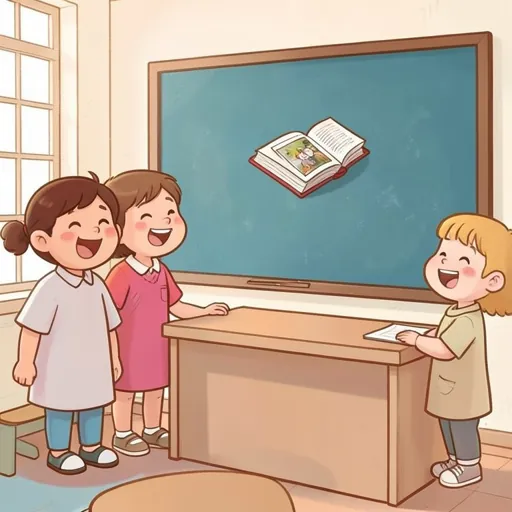
What's Silly? At School
- Game
- 1–3
- 10 pages · 10 min
10 silly school scenes described in words. Find what does not make sense and say what it should be. Built for grades 1–3, it works in pull-out, push-in, or teletherapy, with 10 screens, in about 10 minutes. Skill tags on this board: inferencing, verbal reasoning, absurdities. Plays in the browser with no login; add students to score trials against IEP goals.
Quiz
What's Silly? At School
The teacher writes on the board with a banana. What is silly?
Tap your answer.
Session summary (SOAP)
Stays on this screen. Nothing is saved or sent.
Mark a card Correct, Correct with cue or Incorrect and the summary writes itself here.
How to run it
Read the scene, then ask the student to picture it before looking at the choices. After each answer, ask what should happen instead and why: the teacher needs a marker, the bus needs a road. For a challenge, read the scene once without the choices and ask the student to say what is silly in their own words.
Cueing ladder
Start at the top. Add support one step at a time.
- IndependentPresent the item and wait 5 seconds of quiet before helping.Log as correct
- HintReread the key sentence, or point back to the clue in the text or picture.Log as cued
- Two choicesOffer two answers, the right one not always second.Log as cued
- ModelThink aloud: say how you worked it out, then the student says the answer and why.Log as cued
Adjust it
Read it aloud to the student and offer two choices from the start.
Ask the student to say which words gave them the clue, not just the answer.
Matching IEP goal
Given short texts or spoken prompts, Student will make an inference and say which clue they used in 8 of 10 opportunities across 3 consecutive sessions, given no more than an indirect cue.
Send it home through the parent portal →About this activity
Ten silly scenes from a school day, such as a teacher writing on the board with a banana, recess in a snowstorm in swimsuits, a school bus floating down the river and a class singing happy birthday to a chair. The student chooses what is silly, and the wrong choices are true details from the same scene.
What to listen for
Watch whether the student explains with a reason (a library is quiet) or only repeats the silly part. Reasons show the reasoning this activity is for. Notice too whether longer scenes, such as the soup on paper, need a second reading.
Carrying it home
Ask your child to tell you something silly that could never happen at their school, and then what really happens. Try a 'what's wrong with this picture' drawing together, with one silly thing hidden in it.
What's in this activity
- The teacher writes on the board with a banana. What is silly?
- You write with a marker not a banana
- The teacher is writing
- The board is big
- The class goes out for recess in a snowstorm wearing swimsuits. What is silly?
- Recess is fun
- Swimsuits are for hot weather
- It is snowing
- A student cuts paper with a spoon. What is silly?
- The paper is white
- The student is busy
- Scissors cut paper
- The school bus floats down the river to school. What is silly?
- Buses drive on roads
- The bus is yellow
- School starts soon
- Everyone raises their foot to answer a question. What is silly?
- Everyone knows the answer
- You raise your hand
- The teacher asked a question
- The lunch helper serves soup on a flat piece of paper. What is silly?
- Soup is hot
- It is lunch time
- Soup would spill off paper
- The classroom clock has letters instead of numbers. What is silly?
- A clock shows numbers
- The clock is round
- It is time for math
- The librarian tells everyone to shout in the library. What is silly?
- The library has books
- A library is a quiet place
- The librarian is helping
- The students use glue to erase their mistakes. What is silly?
- Everyone makes mistakes
- Glue is sticky
- An eraser takes away mistakes
- The class sings happy birthday to a chair. What is silly?
- A chair does not have a birthday
- The class likes to sing
- The chair is brown
Questions
- Why school scenes?
- School is a routine students know well, so they can notice what does not fit and explain what should happen.
- What grades is this for?
- First through third grade, or older students who are still building reasoning and explaining skills.
Use this board with your caseload
With a free account, every correct, cued and incorrect mark is saved to the student and scored against their IEP goal, with the data written up for you. Assign it as home practice through the parent portal.
Track progress freeFree for SLPs. No card, no trial clock.