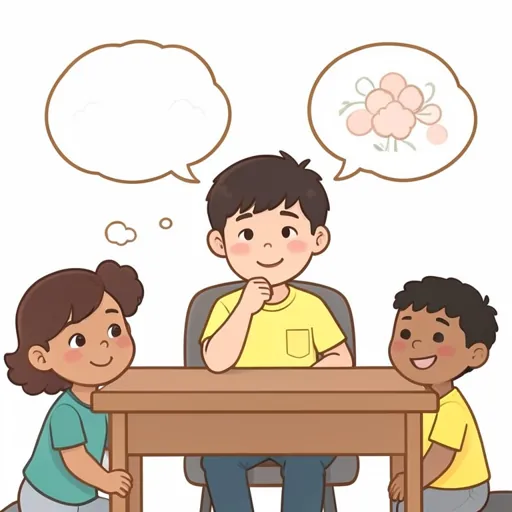
Stop and Think: Pick the Best Choice
- Game
- 3–8
- 10 pages · 10 min
10 moments where the first idea is not the best one. Pause, think about what happens next and pick the best choice. Built for grades 3–8, it works in pull-out, push-in, or teletherapy, with 10 screens, in about 10 minutes. Skill tags on this board: executive function, impulse control, problem solving. Plays in the browser with no login; add students to score trials against IEP goals.
Quiz
Stop and Think: Pick the Best Choice

A friend dares you to jump off the top of the slide. What is the best choice?
Tap your answer.
Session summary (SOAP)
Stays on this screen. Nothing is saved or sent.
Mark a card Correct, Correct with cue or Incorrect and the summary writes itself here.
How to run it
Before the student taps, ask them to say what would happen next for each choice. Practise the pause: count to five or take a breath before answering. Afterwards, talk about a real time the student acted fast and what they might do differently.
Cueing ladder
Start at the top. Add support one step at a time.
- IndependentSet up the situation and wait for the student to respond on their own.Log as correct
- Nonverbal cueUse a look, a gesture or a point to the visual cue card.Log as cued
- Indirect promptAsk 'What could you say now?' or 'How do you think they feel?'Log as cued
- ModelShow what to say or do, then run the moment again so the student can try it.Log as cued
Adjust it
Give a script or two choices of what to say, and practise with you before a peer.
Role-play with a new partner, or add a twist the student has not planned for.
Matching IEP goal
In structured role-plays, Student will use the target conversation skill appropriately in 4 of 5 opportunities across 3 consecutive sessions, given no more than a nonverbal cue.
Send it home through the parent portal →About this activity
Ten moments where the first idea is not the best one: a dare at the top of a slide, an angry text, knowing the answer in class, the last cookie, a stranger online, finishing a test early, being bumped in line, wanting to buy something right away. For each, the student pauses and picks the best choice. The quick choice is always among the options, so stopping to think is the whole task.
What to listen for
Notice whether the student picks the impulsive choice even when they can explain the better one. That gap between knowing and doing is the real target. Watch the online-stranger item for safety knowledge.
Carrying it home
Agree on a family 'stop and think' signal, like a hand up or saying 'pause'. Use it yourself when you are about to react fast, and praise your child when they use it.
What's in this activity
- A friend dares you to jump off the top of the slide. What is the best choice?
- say no and slide down
- jump right away
- dare someone else
- You are angry at a text from a friend. What is the best choice?
- reply in all caps
- wait and reply when calm
- post about it
- The teacher asks a question and you know the answer. What is the best choice?
- shout it out
- whisper it to a friend
- raise your hand
- You see the last cookie but your brother has not had one. What is the best choice?
- share it or let him have it
- eat it fast
- hide it
- A stranger online asks where you live. What is the best choice?
- tell them
- do not answer and tell an adult
- ask why
- You finish a test early. What is the best choice?
- hand it in without looking
- talk to a friend
- check your answers
- Someone bumps you in line. What is the best choice?
- check if it was an accident
- push them back
- yell
- You want to buy something online right now. What is the best choice?
- buy it instantly
- wait a day and see if you still want it
- buy two
- You are told to do a chore during your game. What is the best choice?
- ignore it
- argue for an hour
- pause the game and do the chore
- What helps you stop and think?
- take a breath and count to five
- act fast
- do what others do
Questions
- Is the best choice always obvious?
- Often yes, once you pause. The activity is about building the pause, not tricky questions.
- Why ask what happens next?
- Thinking one step ahead is what stopping to think means in practice.
Use this board with your caseload
With a free account, every correct, cued and incorrect mark is saved to the student and scored against their IEP goal, with the data written up for you. Assign it as home practice through the parent portal.
Track progress freeFree for SLPs. No card, no trial clock.