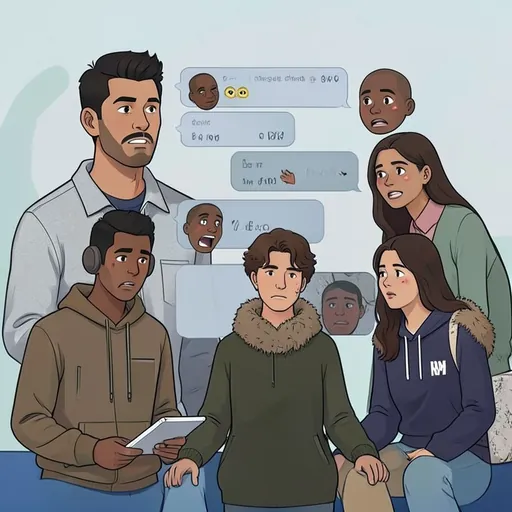
Reading the Tone in a Group Chat
- Game
- 6–12
- 10 pages · 10 min
10 text messages from a group chat. What does the writer probably mean or feel? Practice reading tone without a voice. Built for grades 6–12, it works in pull-out, push-in, or teletherapy, with 10 screens, in about 10 minutes. Skill tags on this board: social communication, perspective taking, non-literal language, teens. Plays in the browser with no login; add students to score trials against IEP goals.
Quiz
Reading the Tone in a Group Chat
Your friend texts 'great. just great.' after the game is canceled. How do they probably feel?
Tap your answer.
Session summary (SOAP)
Stays on this screen. Nothing is saved or sent.
Mark a card Correct, Correct with cue or Incorrect and the summary writes itself here.
How to run it
Read each message aloud in two voices, flat and then with the tone you think it has, and ask which fits. After each answer, ask what clues helped: punctuation, capitals, emoji or what just happened. Point out that a text can be read more than one way, and that checking in is often the best move.
Cueing ladder
Start at the top. Add support one step at a time.
- IndependentSet up the situation and wait for the student to respond on their own.Log as correct
- Nonverbal cueUse a look, a gesture or a point to the visual cue card.Log as cued
- Indirect promptAsk 'What could you say now?' or 'How do you think they feel?'Log as cued
- ModelShow what to say or do, then run the moment again so the student can try it.Log as cued
Adjust it
Give a script or two choices of what to say, and practise with you before a peer.
Role-play with a new partner, or add a twist the student has not planned for.
Matching IEP goal
Given social scenarios, Student will identify another person's thoughts or feelings and give a reason in 8 of 10 opportunities across 3 consecutive sessions, given no more than an indirect prompt.
Send it home through the parent portal →About this activity
Ten group-chat messages, written for teens, where the words alone do not show how the writer feels. There is 'great. just great.' after a canceled game, a one-letter 'k.', 'cool cool cool' after plans change again, all capitals and emoji. The student chooses what the writer probably means or feels, and one question asks for a kind reply.
What to listen for
Notice whether the student reads every message literally, such as taking 'great. just great.' as happy. Also watch for the opposite: reading anger into neutral messages like 'can we talk later?'. Both are common, and both are worth talking through, because they affect friendships.
Carrying it home
Talk with your teen about a message that confused someone in the family. Ask how they would read it and how they might reply. Avoid reading their real messages unless they offer; examples you make up work well.
What's in this activity
- Your friend texts 'great. just great.' after the game is canceled. How do they probably feel?
- annoyed
- excited
- proud
- Someone writes 'LOL that was so funny' after your joke. What do they mean?
- they are mad at you
- they liked your joke
- they want to leave the chat
- A classmate replies 'k.' to your long message about weekend plans. What might it mean?
- they are very excited
- they want a longer message
- they may be busy or upset so check in later
- Your friend types 'WHAT?? NO WAY!!' after you share good news. How do they feel?
- surprised and happy for you
- bored
- sleepy
- Someone writes 'nice job forgetting the snacks' with an eye-roll emoji. What is the tone?
- thankful
- teasing or annoyed
- worried
- Your friend sends 'are you mad at me?' after you did not reply for hours. What is a kind reply?
- Say nothing again
- Why would you even ask that
- No! I was just busy. What's up?
- After plans change for the third time someone posts 'cool cool cool.' What could it mean?
- they are frustrated but going along with it
- they are cold
- they love the new plan
- Your friend writes 'can we talk later?' with no emoji. What is the best way to read it?
- they are angry at the whole group
- they want to talk about something later
- they are joking
- Someone replies to your photo with three laughing faces. What is the tone?
- angry
- worried
- playful
- A message in all capital letters says 'PRACTICE MOVED TO 4.' What do the capitals most likely mean?
- it is important news to notice
- the writer is yelling at you
- it is a joke
Questions
- Why practise tone in texts?
- Texts have no voice or face, so students rely on punctuation, emoji and context. Misreading tone is a common cause of friendship problems.
- Is there always one right answer?
- Usually there is a most likely reading. When a message is unclear, the best skill is often to ask.
Use this board with your caseload
With a free account, every correct, cued and incorrect mark is saved to the student and scored against their IEP goal, with the data written up for you. Assign it as home practice through the parent portal.
Track progress freeFree for SLPs. No card, no trial clock.