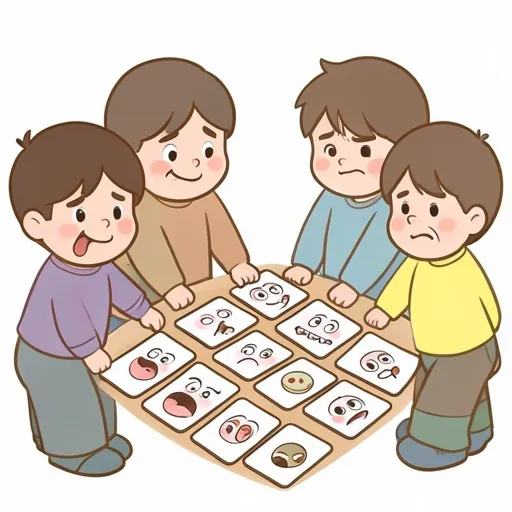
Happy, Sad or Mad? Sort the Faces
- Sorting
- PreK–2
- 1 page · 8 min
Twelve pictured faces and bodies to sort into happy, sad, and mad: smiling at a birthday cake, laughing on the swings, crying after a fall, frowning at a broken toy, stomping with crossed arms, glaring at a knocked-over tower, and more. Before placing each card, have the student name the feeling and one face clue, such as the mouth, eyes, or eyebrows. Score each answer as independent, cued, or modeled in your own data.
Sort it
Happy, Sad or Mad? Sort the Faces
Say the word, then put it in the right basket.
drop here
drop here
drop here
How to run it
Name the groups first. The student places each picture, says what clue they used, and then you move on. If a card lands in the wrong group, ask what the picture shows before you move it. Work through the set once for a baseline, then return to the cards that were hard. Keep your own data: mark independent, cued, or modeled trials in your session notes.
Cueing ladder
Start at the top. Add support one step at a time.
- IndependentPresent the situation and wait 5 seconds of quiet before helping.Log as correct
- HintPoint to the part of the situation that matters, or ask what the other person might think.Log as cued
- Two choicesGive two possible lines and let the student pick one and say it.Log as cued
- ModelModel a full line the student can repeat, then try the next card.Log as cued
Adjust it
Sort only happy and sad first, with four cards each, and model the face yourself.
Ask how big the feeling is, a little or a lot, and what the person could do next.
Matching IEP goal
Given pictured faces, Student will name the feeling shown and one facial clue that supports it in 8 of 10 opportunities across 3 consecutive sessions, given no more than an indirect cue.
Send it home through the parent portal →About this activity
Happy, Sad or Mad? Sort the Faces is a group sort board for preschool through grade 2 students. Twelve pictured faces and bodies to sort into happy, sad, and mad: smiling at a birthday cake, laughing on the swings, crying after a fall, frowning at a broken toy, stomping with crossed arms, glaring at a knocked-over tower, and more. Before placing each card, have the student name the feeling and one face clue, such as the mouth, eyes, or eyebrows. Score each answer as independent, cued, or modeled in your own data. It is a word-level board for a short therapy block or a station; you score the responses yourself.
What to listen for
Listen for the clue the student gives: the mouth turned up or down, the eyebrows, tears, or crossed arms. A right sort with no clue counts as cued for the facial expressions goal. Feelings can look different on different faces, so talk about why a card might fit two groups. Examples on this board include smiling at a birthday cake, laughing on the swings, hugging a new puppy, stomping with crossed arms, and glaring at a knocked-over tower.
Carrying it home
When reading a picture book, stop on a face and ask how the character feels and how your child can tell. Make faces in a mirror together: show me happy, now show me mad. Keep it short and playful.
What's in this activity
- Happy
- Sad
- Mad
Questions
- Who is this for?
- This board is for preschool through grade 2 students working on the skill in the description, with items such as smiling at a birthday cake, laughing on the swings, and hugging a new puppy.
- What comes next?
- Move to the How Big Is the Feeling boards once happy, sad and mad are steady. To make it easier: sort only happy and sad first, with four cards each, and model the face yourself.
- Is it free?
- Yes. It plays free in the browser with no login. An account adds session data, goal scoring, and assignment to a student.
Use this board with your caseload
With a free account, every correct, cued and incorrect mark is saved to the student and scored against their IEP goal, with the data written up for you. Assign it as home practice through the parent portal.
Track progress freeFree for SLPs. No card, no trial clock.