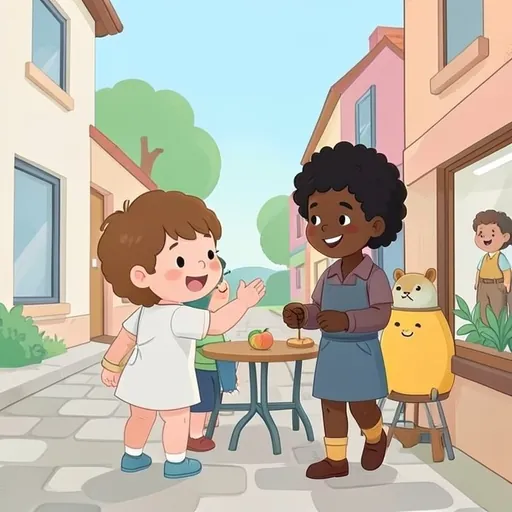
Around Town: What Would You Say?
- Game
- 3–8
- 10 pages · 10 min
10 everyday moments around town: the library, the pharmacy counter, the bus, a bakery line. Pick what to say. Built for grades 3–8, it works in pull-out, push-in, or teletherapy, with 10 screens, in about 10 minutes. Skill tags on this board: social skills, community, conversation. Plays in the browser with no login; add students to score trials against IEP goals.
Quiz
Around Town: What Would You Say?
At the library you cannot find a book. What could you say?
Tap your answer.
Session summary (SOAP)
Stays on this screen. Nothing is saved or sent.
Mark a card Correct, Correct with cue or Incorrect and the summary writes itself here.
How to run it
Read each moment and act it out after the student chooses: you play the librarian or the cashier and the student says the line. Ask how the other person would feel after each choice. Then let the student set up a moment from their own neighborhood for you to answer.
Cueing ladder
Start at the top. Add support one step at a time.
- IndependentSet up the situation and wait for the student to respond on their own.Log as correct
- Nonverbal cueUse a look, a gesture or a point to the visual cue card.Log as cued
- Indirect promptAsk 'What could you say now?' or 'How do you think they feel?'Log as cued
- ModelShow what to say or do, then run the moment again so the student can try it.Log as cued
Adjust it
Give a script or two choices of what to say, and practise with you before a peer.
Role-play with a new partner, or add a twist the student has not planned for.
Matching IEP goal
In structured role-plays, Student will use the target conversation skill appropriately in 4 of 5 opportunities across 3 consecutive sessions, given no more than a nonverbal cue.
Send it home through the parent portal →About this activity
Ten everyday moments around town: asking a librarian for help, thanking someone who holds a door, bumping into someone on the bus, someone cutting in line at the bakery, not hearing your name at the pharmacy counter. For each, the student picks what to say. The wrong choices are either rude or say nothing, which are the two ways these moments usually go wrong.
What to listen for
Notice whether the student picks polite but also clear answers. 'Excuse me I think I was next' is both. Watch for students who choose to say nothing, which can come from anxiety more than not knowing what to say; practising the line aloud helps.
Carrying it home
On errands, give your child a small speaking job: asking where something is, thanking the cashier, ordering a drink. Practise the line in the car first if that helps.
What's in this activity
- At the library you cannot find a book. What could you say?
- Excuse me can you help me find a book
- Where is it
- Nothing and leave
- Someone holds the door for you. What do you say?
- Hurry up
- Thank you
- Move
- You bump into someone on the bus. What do you say?
- Watch it
- Say nothing
- Sorry about that
- The cashier says have a nice day. What do you say?
- Thanks you too
- Why
- Turn around and leave
- At the bakery someone cuts in front of you. What could you say?
- Shout at them
- Excuse me I think I was next
- Push them
- You want to sit on the bench where someone has a bag. What do you say?
- Move your bag
- Sit on the bag
- Is this seat free
- At the pharmacy counter you did not hear your name. What do you say?
- Sorry could you say that again
- What
- Leave
- A neighbor waves at you. What can you do?
- Look away
- Wave back and say hi
- Run inside
- At the park a kid asks to join your game. What can you say?
- Go away
- Ignore them
- Sure you can play
- You ordered the wrong size drink. What could you say?
- Sorry could I change it to a small
- This is wrong
- Throw it away
Questions
- Why community settings?
- These are the places students go with family and later alone, so the words carry over directly.
- What about speaking up in line?
- One question covers someone cutting in. A calm, clear sentence is the target, not arguing.
Use this board with your caseload
With a free account, every correct, cued and incorrect mark is saved to the student and scored against their IEP goal, with the data written up for you. Assign it as home practice through the parent portal.
Track progress freeFree for SLPs. No card, no trial clock.