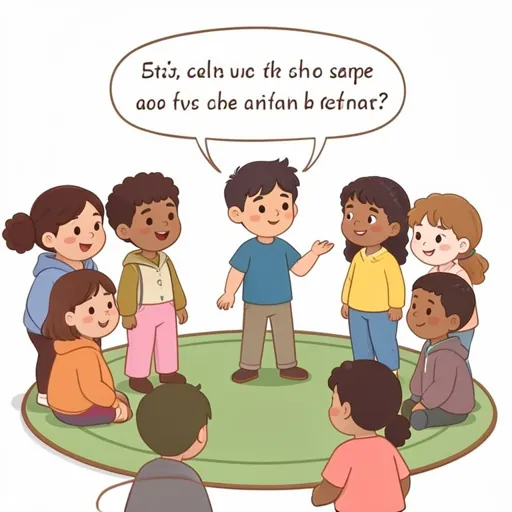
Join the Discussion: What Is the Best Next Move?
- Game
- 6–12
- 10 pages · 10 min
Ten class discussion moments with three choices each: a silent group, an idea you disagree with, a point you did not follow, a drifting topic, one voice taking over, adding to an idea, a request for evidence, a heated argument, realizing you were wrong, and sharing out for the group. Read each moment, let the student pick the best next move, and then have them say the line out loud as if in class. Score each choice and each spoken line as independent, cued, or modeled in your own data.
Quiz
Join the Discussion: What Is the Best Next Move?
Your group is quiet and nobody wants to start. What could you do?
Tap your answer.
Session summary (SOAP)
Stays on this screen. Nothing is saved or sent.
Mark a card Correct, Correct with cue or Incorrect and the summary writes itself here.
How to run it
Read each card or situation aloud, let the student respond, and then ask why. When they find a good answer, role-play it out loud before the next card so the line is practiced, not only chosen. Work through the set once for a baseline, then return to the cards that were hard. Keep your own data: mark independent, cued, or modeled trials in your session notes.
Cueing ladder
Start at the top. Add support one step at a time.
- IndependentPresent the situation and wait 5 seconds of quiet before helping.Log as correct
- HintPoint to the part of the situation that matters, or ask what the other person might think.Log as cued
- Two choicesGive two possible lines and let the student pick one and say it.Log as cued
- ModelModel a full line the student can repeat, then try the next card.Log as cued
Adjust it
Give two choices instead of three, and model the spoken line first.
Have the student lead a short real discussion and use three different moves.
Matching IEP goal
Given a class discussion situation, Student will choose and produce an expected next move that keeps the discussion on topic and inclusive in 8 of 10 opportunities across 3 consecutive sessions, given no more than an indirect cue.
Send it home through the parent portal →About this activity
Join the Discussion: What Is the Best Next Move? is a quiz board for middle and high school students. Ten class discussion moments with three choices each: a silent group, an idea you disagree with, a point you did not follow, a drifting topic, one voice taking over, adding to an idea, a request for evidence, a heated argument, realizing you were wrong, and sharing out for the group. Read each moment, let the student pick the best next move, and then have them say the line out loud as if in class. Score each choice and each spoken line as independent, cued, or modeled in your own data. It is a sentence-level board for a short therapy block or a station; you score the responses yourself.
What to listen for
Listen for the spoken line after each choice; that is what the student will use in class. Moves that keep the group on topic and bring in other voices show the strongest participation. Note which moments bring a quiet or a combative response, and rehearse those lines. Examples on this board include your group is quiet and nobody wants to start. what could you do, and someone shares an idea you think is wrong. what is a respectful move.
Carrying it home
Before a group project or seminar, ask your teen which move they could try, such as getting the group started or bringing it back on topic. Afterwards, ask how it went. Keep it short and low pressure.
What's in this activity
- Your group is quiet and nobody wants to start. What could you do?
- Wait until the teacher picks someone
- Offer one idea to get it started
- Start talking about something else
- Someone shares an idea you think is wrong. What is a respectful move?
- I see it differently and here is why.
- That is a terrible idea.
- Roll your eyes and stay quiet
- You did not understand a classmate's point. What do you say?
- Pretend you understood
- Change the subject
- Can you say that another way?
- The discussion has drifted off topic. What could you say?
- Bring up another new topic
- Let us get back to the question.
- Stop talking for the rest of class
- One person keeps doing all the talking. What is a good move?
- What do the rest of you think?
- Talk louder than them
- Leave the group
- You want to add to what someone said. How can you start?
- Wait. No. Listen to me.
- Interrupt with your idea
- To add to that point
- Someone asks you for evidence. What do you do?
- Say you just know
- Point to the page or source you used
- Get annoyed
- Two people are arguing and it is getting heated. What could you say?
- Let us look at what we agree on first.
- Pick a side and argue too
- Laugh at them
- You realize you were wrong about something. What can you say?
- Say nothing and hope nobody noticed
- Keep arguing anyway
- Good point. I think I was wrong about that.
- The teacher asks your group to share out. What is a good way to do it?
- Read every note word for word
- Sum up the main idea in two sentences
- Say we did not really decide
Questions
- Who is this for?
- This board is for middle and high school students working on the skill in the description, with items such as your group is quiet and nobody wants to start. what could you do, and someone shares an idea you think is wrong. what is a respectful move.
- What comes next?
- Lead or join a real class discussion and use one move from this board. To make it easier: give two choices instead of three, and model the spoken line first.
- Is it free?
- Yes. It plays free in the browser with no login. An account adds session data, goal scoring, and assignment to a student.
Use this board with your caseload
With a free account, every correct, cued and incorrect mark is saved to the student and scored against their IEP goal, with the data written up for you. Assign it as home practice through the parent portal.
Track progress freeFree for SLPs. No card, no trial clock.