Secret Swap: Animal Words
- Game
- 2–4
- 1 page · 8 min
Picture card memory game: name, keep, or swap animal cards. Built for grades 2–4, it works in pull-out, push-in, or teletherapy, in about 8 minutes. Sample stimuli: cat, dog, fish, bird, horse, and more. Plays in the browser with no login; add students to score trials against IEP goals.
Secret swap
Secret Swap: Animal Words
Memorize your first two cards…
Lowest total wins when the draw pile is empty.
How to run it
Play the intro peek together — talk about what they saw. On each draw, wait for naming before tapping 'I named it.' Discuss strategy in simple terms ('Do you want a low number or this cat?').
Cueing ladder
Start at the top. Add support one step at a time.
- IndependentWait three seconds for the student to name, match, or place without help.Log as correct
- VisualPoint to the picture, card, or drop zone and model the first sound.Log as cued
- Indirect promptAsk a wh- question: 'Where does it go?' or 'What is this?'Log as cued
- ModelSay the word or carrier sentence; the student repeats.Log as cued
Adjust it
Reduce the number of items, name together before each turn, or preview the scene aloud.
Student explains why an item belongs or uses a longer sentence frame.
Matching IEP goal
During a structured card game, Student will name pictured vocabulary from memory and decide whether to keep or swap a card in 8 of 10 opportunities across 3 sessions, given no more than a visual prompt.
Send it home through the parent portal →About this activity
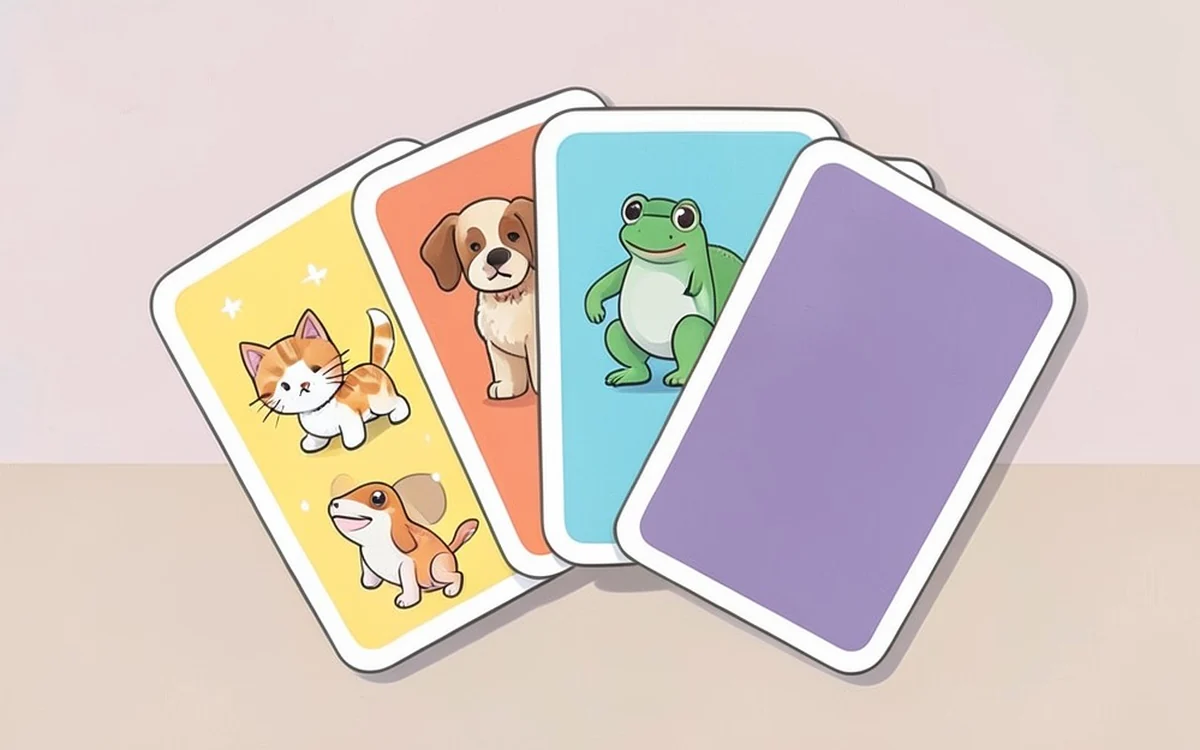
Large picture cards, a visible draw pile and discard pile, student and computer hands, and clear prompts ('Name it! Keep or swap?'). Peek and Swap power cards look different from animal cards. Students name each drawn animal before deciding to swap into their hand or discard.
What to listen for
Track naming accuracy under light pressure. Note whether memory of face-down cards improves across rounds. Power cards reveal whether they follow multi-step directions.
Carrying it home
Play with a small deck of picture cards at the table. Use the same 'name it first' rule before keeping a card. Carry the same words into a short routine at home so practice stays playful rather than feeling like homework.
What's in this activity
- cat
- dog
- fish
- bird
- horse
- cow
- duck
- frog
Questions
- Who is this for?
- Preschool through early elementary students working on naming, categories, short sentences, or working memory in a play-based format.
- Can I change the words or pictures?
- Yes. Open the activity in Activity Studio, edit the word list or scene zones, or duplicate it and swap templates.
- Is it free?
- Yes. It plays in the browser with no login. An account adds session data, goal scoring, and assignment to a student.
Use this board with your caseload
With a free account, every correct, cued and incorrect mark is saved to the student and scored against their IEP goal, with the data written up for you. Assign it as home practice through the parent portal.
Track progress freeFree for SLPs. No card, no trial clock.