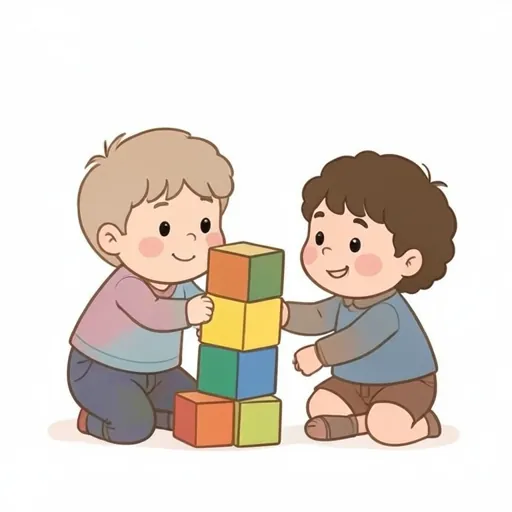
Saying Sorry and Making It Better
- Game
- K–4
- 10 pages · 10 min
Ten small accidents and mistakes: you bump a friend's tower, you step on a foot, you spill a classmate's water, you say something that hurt. The student picks what to say and do to make it better, then says it out loud. A good sorry names what happened and offers to help. Score each line as independent, cued, or modeled in your own data.
Quiz
Saying Sorry and Making It Better
You bump a friend's block tower and it falls. What can you say?
Tap your answer.
Session summary (SOAP)
Stays on this screen. Nothing is saved or sent.
Mark a card Correct, Correct with cue or Incorrect and the summary writes itself here.
How to run it
Read each situation aloud, let the student choose, and then ask why. When they find a line worth trying, role-play it out loud before the next card so the words are practiced, not only chosen. Accept a different answer when the reason is sound. Work through the set once for a baseline, then return to the cards that were hard. Keep your own data: mark independent, cued, or modeled trials in your session notes.
Cueing ladder
Start at the top. Add support one step at a time.
- IndependentPresent the situation and wait 5 seconds of quiet before helping.Log as correct
- HintPoint to the part of the situation that matters, or ask what the other person might think.Log as cued
- Two choicesGive two possible lines and let the student pick one and say it.Log as cued
- ModelModel a full line the student can repeat, then try the next card.Log as cued
Adjust it
Practice one frame on every card: sorry I and then what happened. Give two choices.
Cover the choices and have the student say all three parts: sorry, what happened, and how to make it better.
Matching IEP goal
Given a described accident or mistake with a peer, Student will produce an apology that names what happened and offers a repair in 8 of 10 opportunities across 3 consecutive sessions, given no more than an indirect cue.
Send it home through the parent portal →About this activity
Saying Sorry and Making It Better is a quiz board for kindergarten through grade 4 students. Ten small accidents and mistakes: you bump a friend's tower, you step on a foot, you spill a classmate's water, you say something that hurt. The student picks what to say and do to make it better, then says it out loud. A good sorry names what happened and offers to help. Score each line as independent, cued, or modeled in your own data. It suits a short therapy block, a small group or a station; you score the responses yourself.
What to listen for
Listen for the two parts beyond the word sorry: what happened, and what the student will do about it. A fast sorry with no fix is the common miss. Do not force a sorry in the moment a student is still upset; the board is practice for later. Items include you bump a friend's block tower and it falls, and a friend says sorry to you for bumping you.
Carrying it home
When a small accident happens at home, help your child with the two parts: sorry I spilled it, and I will get a towel. Say sorry to your child the same way when you make a mistake. Children copy the fix more than the word.
What's in this activity
- You bump a friend's block tower and it falls. What can you say?
- Sorry I knocked it down. I will help rebuild
- It was a bad tower anyway
- Run away fast
- You step on a classmate's foot in line. What can you say?
- Your foot was in my way
- Sorry. Are you okay?
- Say nothing and keep walking
- You spill a classmate's water on their paper. What can you do?
- Blame the child next to you
- Laugh and point at it
- Say sorry and get paper towels
- You said a friend's picture was ugly. Your friend looks sad. What can you say?
- Sorry I said that. It was not kind
- It is ugly though
- Stop being so sad
- You took a marker without asking. What can you say?
- You have lots of markers
- Sorry I did not ask. Here it is
- Hide the marker in your desk
- You forgot to save a seat for your friend. What can you say?
- You should have come faster
- Pretend you did not see them
- Sorry I forgot. Sit with me tomorrow?
- You were too loud and a friend covered their ears. What can you say?
- Sorry. I will be quieter
- You are too sensitive
- Get even louder
- You broke a friend's crayon by accident. What can you do?
- Put it back in the box quietly
- Say sorry and offer one of yours
- Say the crayon was old
- You said sorry but your friend is still upset. What can you do?
- Yell that you already said sorry
- Tell them to get over it
- Give them some time and try again later
- A friend says sorry to you for bumping you. What can you say?
- That is okay. Thanks for saying sorry
- I will never forgive you
- Bump them back
Questions
- Who is this for?
- This board is for kindergarten through grade 4 students working on social skills, with items such as you bump a friend's block tower and it falls. what can you say, and you step on a classmate's foot in line. what can you say.
- What comes next?
- Role-play two cards with a peer, then try the playground problems quiz. To make it easier: practice one frame on every card: sorry I and then what happened. Give two choices.
- Is it free?
- Yes. It plays free in the browser with no login. An account adds session data, goal scoring, and assignment to a student.
Use this board with your caseload
With a free account, every correct, cued and incorrect mark is saved to the student and scored against their IEP goal, with the data written up for you. Assign it as home practice through the parent portal.
Track progress freeFree for SLPs. No card, no trial clock.