Concordancia de género: el o la
Clasificar sustantivos por género y usar el artículo correcto. Objetivo morfosintáctico propio del español.
Drop here
Drop here

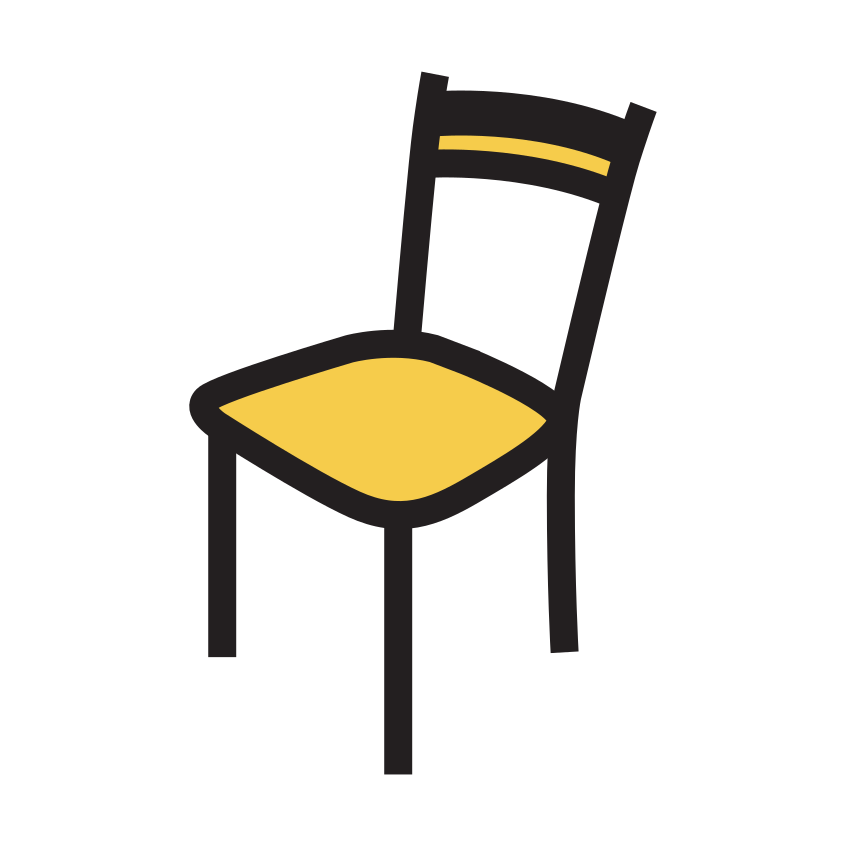









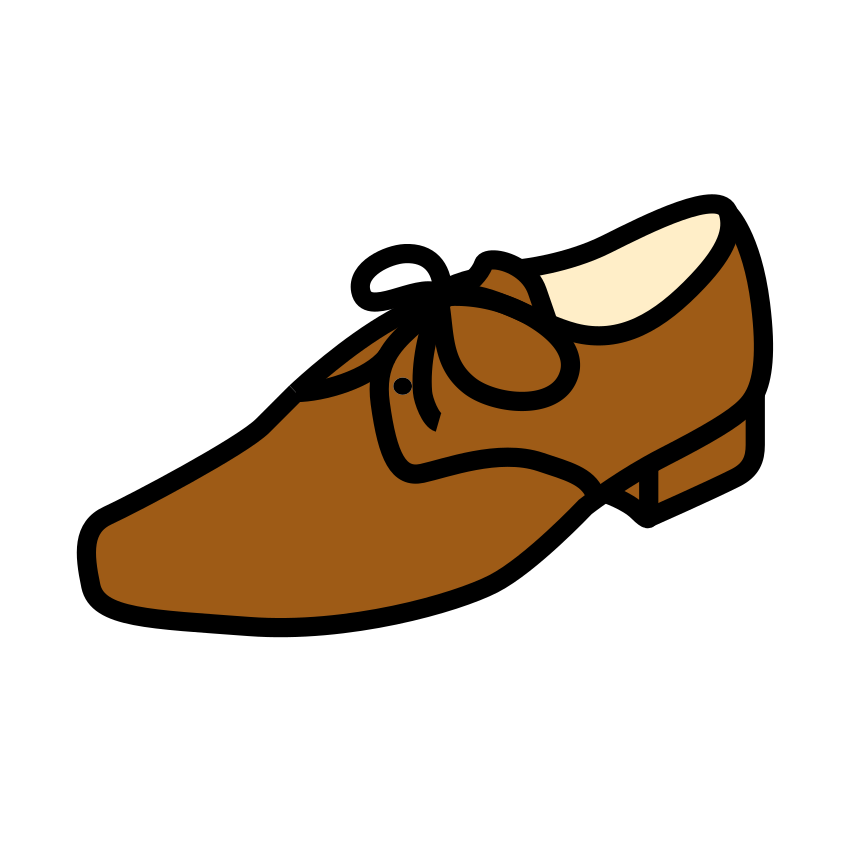

0/14 sorted
How to run it
Say the article and the noun together every time — la mesa, el libro — because the pair is the unit being learned and a noun sorted silently teaches nothing. Once the sorting is accurate, ask for the noun with an adjective, since agreement then has to carry through: la mesa grande, el libro nuevo. Ten minutes covers the fourteen nouns with the adjective extension.
Cueing ladder
Start at the top. Add support one step at a time.
- IndependentPresent the item and wait 5 seconds of quiet before helping.Log as correct
- HintStress the part of the sentence that changes, or point to the word ending.Log as cued
- Sentence starterSay the first half of the sentence and let the student finish it.Log as cued
- ModelSay the correct form in the whole sentence; the student repeats it.Log as cued
Adjust it
Give a sentence starter every time, and do fewer cards.
Ask for a new sentence of the student's own with the same form, with no card to lean on.
Matching IEP goal
Given sentence cards, Student will produce article-noun gender agreement in sentences in 8 of 10 opportunities across 3 consecutive sessions, given no more than an indirect cue.
Send it home through the parent portal →About this activity
Fourteen Spanish nouns sorted by the article they take: mesa, silla, casa, ventana, escuela, maestra and mochila go with la; libro, perro, carro, lápiz, cuaderno, zapato and plato go with el. Grammatical gender is a morphosyntactic target that belongs to Spanish and has no English equivalent, which is exactly why it needs a Spanish board rather than a translated English one.
What to listen for
Watch the endings. Most of the la nouns here end in -a and most of the el nouns in -o, which is the pattern children use — so the informative items are lápiz and cuaderno, where the ending does not do the work. A student who is accurate on mesa and casa and guesses on lápiz is applying the rule correctly and has met its limit, which is normal and different from not having the rule at all.
Carrying it home
Gender agreement is learned through hearing it, not through rules. A family speaking Spanish at home is already supplying thousands of correct pairs a week; the useful addition is recasting — the child says el mesa, an adult says la mesa, sí, and the conversation carries on.
What's in this activity
- la
- el
Questions
- Is this board in Spanish?
- Yes, entirely. This page is written in English so an English-speaking clinician can find and evaluate the activity, but the board itself is Spanish.
- Do I need an account?
- No, it plays free in the browser with no login.
- Is gender error a sign of a language disorder?
- Not on its own. Gender agreement is acquired gradually and errors are typical in young Spanish speakers. What matters is whether the pattern is unusual for the child's age and exposure, which needs a broader picture than one board.
Use this board with your caseload
With a free account, every correct, cued and incorrect mark is saved to the student and scored against their IEP goal, with the data written up for you. Assign it as home practice through the parent portal.
Track progress freeFree for SLPs. No card, no trial clock.