/t/ /d/ /n/ Flashcards
Alveolar sounds drill in initial position.
Session summary (SOAP)
Stays on this screen. Nothing is saved or sent.
Mark a card Correct, Correct with cue or Incorrect and the summary writes itself here.
How to run it
Show the shared placement first. All three sounds put the tongue in the same spot, so a child who can make one can make all three with a change of voicing or airflow. Use a mirror for the tongue tip and a hand on the nose for /n/, since air coming through the nose is easy to feel. Five minutes covers the six words, which makes this a short activity for a young child.
Cueing ladder
Start at the top. Add support one step at a time.
- IndependentAfter building each word, the student says it aloud. Wait 3 seconds.Log as correct
- Visual cuePoint to your mouth, or show the mouth picture for /t/, /d/ and /n/, before the student tries again.Log as cued
- Verbal modelSay the word; the student says it right after you.Log as cued
- Placement cueTongue tip on the bumpy ridge behind your top teeth: drop it quietly for /t/, with voice for /d/, and hum through your nose for /n/.Log as cued
Adjust it
Go back to /t/, /d/ and /n/ on their own or in syllables, and use fewer cards.
Put each word in a short carrier phrase with no /t/, /d/ or /n/ in it.
Matching IEP goal
Given word cards, Student will produce /t/, /d/ and /n/ in single words in 8 of 10 opportunities across 3 consecutive sessions, given no more than a visual cue.
Send it home through the parent portal →About this activity
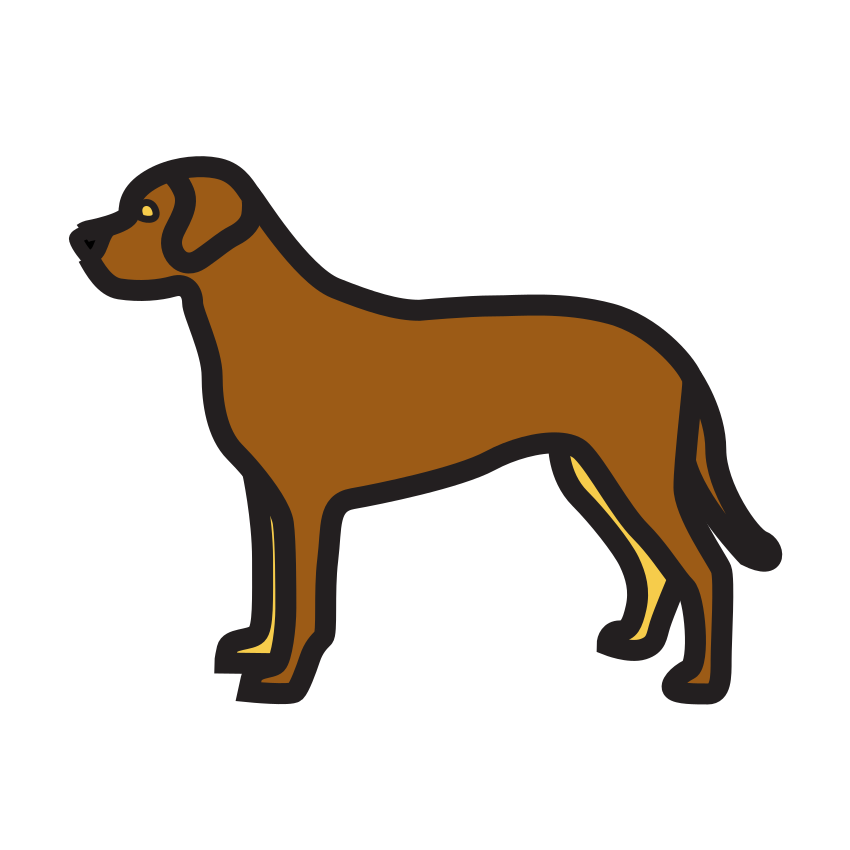
Six short words for the three alveolar sounds: dog, net, tap, den, nap, tin. All are made with the tongue tip at the ridge behind the top teeth, and they differ from each other only in voicing and in whether the air goes through the nose — which makes them a natural group to work together.
What to listen for
Listen for which dimension is wrong. Ten for den is a voicing error; den for nen is a nasality one, and they need different cues — voicing responds to the throat, nasality to holding the nose briefly and hearing the sound change. Watch tin and den, which differ in both dimensions and are the hardest pair here.
Carrying it home
Dog, nap and tap are ordinary words for a young child. Modelling them clearly and noticing the correct ones does more than correcting the incorrect ones at this age.
What's in this activity
- dog
- net
- tap
- den
- nap
- tin
Questions
- What ages is this for?
- Kindergarten through second grade, and often preschool.
- Is it free?
- Yes, all six cards play with no login.
- Why group these three sounds?
- Because they share a tongue position. /t/, /d/ and /n/ are all made at the same place and differ only in voicing and nasality, so a child who has one has most of what the others need.
Use this board with your caseload
With a free account, every correct, cued and incorrect mark is saved to the student and scored against their IEP goal, with the data written up for you. Assign it as home practice through the parent portal.
Track progress freeFree for SLPs. No card, no trial clock.