Route Recall: Park Paths
- Game
- K–2
- 1 page · 8 min
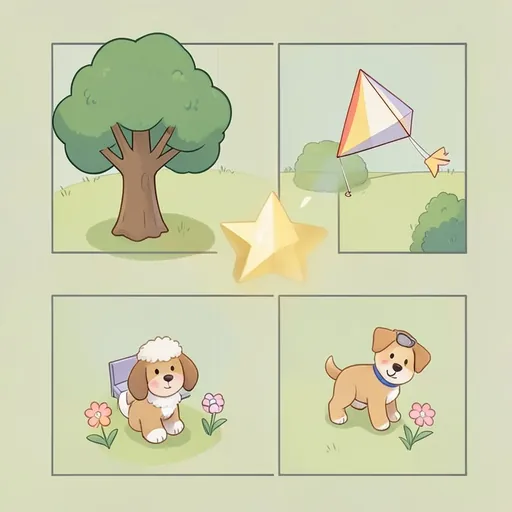
Watch a star visit squares on a 4 by 4 park picture grid, then tap the same route: tree, bench, ball and kite and more. Built for grades K–2, it works in pull-out, push-in, or teletherapy, in about 8 minutes. Sample stimuli: tree, bench, ball, kite, dog, and more. Plays in the browser with no login; add students to score trials against IEP goals.
Route recall
Route Recall: Park Paths
Watch where the star goes…
How to run it
Play the first route together and say the order out loud as the star moves. After that, let the student watch quietly and tap on their own. When a route is missed, the board shows the right route with numbers, so trace it together with a finger before going on to the next one.
Cueing ladder
Start at the top. Add support one step at a time.
- IndependentLet the student watch the route and tap it back on their own.Log as correct
- Finger followHave the student follow the star with a finger in the air while it moves.Log as cued
- Chunk itSay the route in two parts as it plays: 'top, top, then the middle.'Log as cued
- ModelTap the first square of the route for the student, then let them tap the rest.Log as cued
Adjust it
Stay on 3 square routes and let the student say each square's picture as the star lands.
Ask the student to tap the route backwards, last square first.
Matching IEP goal
Given a route shown on a picture grid, Student will tap the same places in the same order for routes of 4 places in 8 of 10 opportunities across 3 consecutive sessions.
Send it home through the parent portal →About this activity
A route memory board set in a park. The grid is 4 by 4 squares, each showing a picture such as tree, bench, ball and kite, and each picture appears more than once. A star visits some squares one at a time, then the student taps the same squares in the same order. The route starts at 3 squares, grows by one after a correct route and shrinks by one after a miss, up to 6.
What to listen for
Young students often remember the first square or two and then guess. Each route is one trial, marked with its length, so the summary shows the longest route the student holds reliably. Notice whether misses come at the start of a route or at the end.
Carrying it home
Hide a toy in a room and walk your child to it by a route of three stops, like the door, the chair and the window. Then have your child lead the same route back.
What's in this activity
- tree
- bench
- ball
- kite
- dog
- flower
- bird
- bee
- butterfly
- leaf
Questions
- What does this practise?
- Visual-spatial memory: holding a short path of places in mind and repeating it in order, a skill used when following directions around a room or keeping your place on a page.
- Why does each picture appear more than once?
- If every square had its own picture, a student could remember a list of names like tree, bench, ball instead of places. Repeating the pictures means the route has to be remembered by where the squares are.
Use this board with your caseload
With a free account, every correct, cued and incorrect mark is saved to the student and scored against their IEP goal, with the data written up for you. Assign it as home practice through the parent portal.
Track progress freeFree for SLPs. No card, no trial clock.