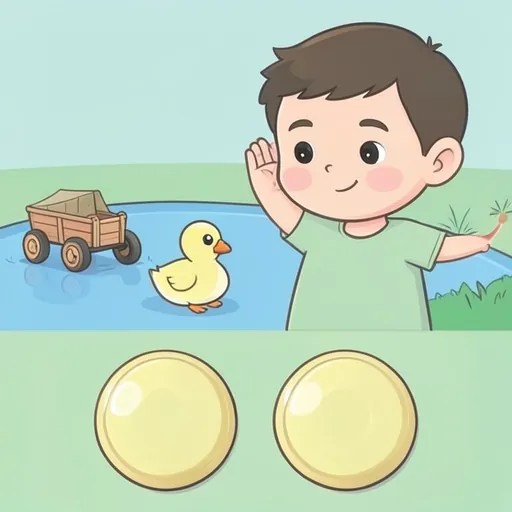
Listen & Tap: Gliding /l/ or /w/
- Game
- K–3
- 1 page · 8 min
7 minimal pairs for gliding of /l/. The board says one word of each pair and the student taps the one they heard: lake/wake, light/white, lip/whip and lick/wick and more. Built for grades K–3, it works in pull-out, push-in, or teletherapy, in about 8 minutes. Sample stimuli: lake – wake, light – white, lip – whip, lick – wick, lag – wag, and more. Plays in the browser with no login; add students to score trials against IEP goals.
Listen & tap
Listen & Tap: Gliding /l/ or /w/
Listen. Which word did you hear?
How to run it
Sit beside the student so you both hear the same audio, with the volume a little higher than usual. Let the board say the word and give the student a few seconds to tap. Replay a word once before helping. Listening comes before saying here: a student who cannot yet hear that two words differ has nothing to aim for when producing them, so a round of this works well before production practice with the same pairs.
Cueing ladder
Start at the top. Add support one step at a time.
- IndependentLet the board say the word and wait 3 seconds for the student to tap the one they heard.Log as correct
- ReplayPlay the word once more at the same speed and ask the student to listen for /l/ and /w/.Log as cued
- ContrastSay both words of the pair back to back, such as lake and wake, then say the target word again.Log as cued
- Show itShow the tongue tip lifting to the bump behind the top teeth for /l/ in lake, and the rounded lips for /w/ in wake.Log as cued
Adjust it
Use fewer pairs, and say each word twice with a pause before the student taps.
Have the student say the word they heard aloud, then judge whether their own word matched.
Matching IEP goal
Given spoken minimal pairs such as lake and wake, Student will identify which word was said, telling apart /l/ and /w/, in 8 of 10 opportunities across 3 consecutive sessions, given no more than one repetition.
Send it home through the parent portal →About this activity
7 minimal pairs for gliding of /l/: lake and wake, light and white, lip and whip, lick and wick, lag and wag, led and wed and leap and weep. The board says one word from a pair and the student taps the word they heard; each pair comes up twice, once for each word, in a shuffled order. The two words differ by one sound, so a right answer means the student heard /l/ and /w/. The /l/ words are all word-initial, where the tongue-tip lift is easiest to see and to hear.
What to listen for
Track which pairs are missed. Errors spread across the board point to difficulty hearing /l/ and /w/ in general; errors on one or two pairs, such as lake and wake, may be about those words rather than the sound. A student who taps correctly but still says wake for lake hears the difference and is ready to work on making it.
Carrying it home
Say one word from a pair, such as lake or wake, and let your child point to the right word or a quick drawing on paper. Then swap: your child says a word and you point to what you heard. If you point to the other one, that is a friendly signal to try the word again, not as a mistake.
What's in this activity
- lake – wake
- light – white
- lip – whip
- lick – wick
- lag – wag
- led – wed
- leap – weep
Questions
- Who is this for?
- Students in kindergarten through grade 3 working on gliding of /l/, or any student whose speech collapses /l/ and /w/ and who needs to hear the difference first.
- Does the student have to say the words?
- No. This board practises listening only. Once the student hears the difference reliably, use the same pairs for production practice.
Use this board with your caseload
With a free account, every correct, cued and incorrect mark is saved to the student and scored against their IEP goal, with the data written up for you. Assign it as home practice through the parent portal.
Track progress freeFree for SLPs. No card, no trial clock.