/g/ Medial Flashcards
Conventional medial /g/ targets at the single-word level.
Session summary (SOAP)
Stays on this screen. Nothing is saved or sent.
Mark a card Correct, Correct with cue or Incorrect and the summary writes itself here.
How to run it
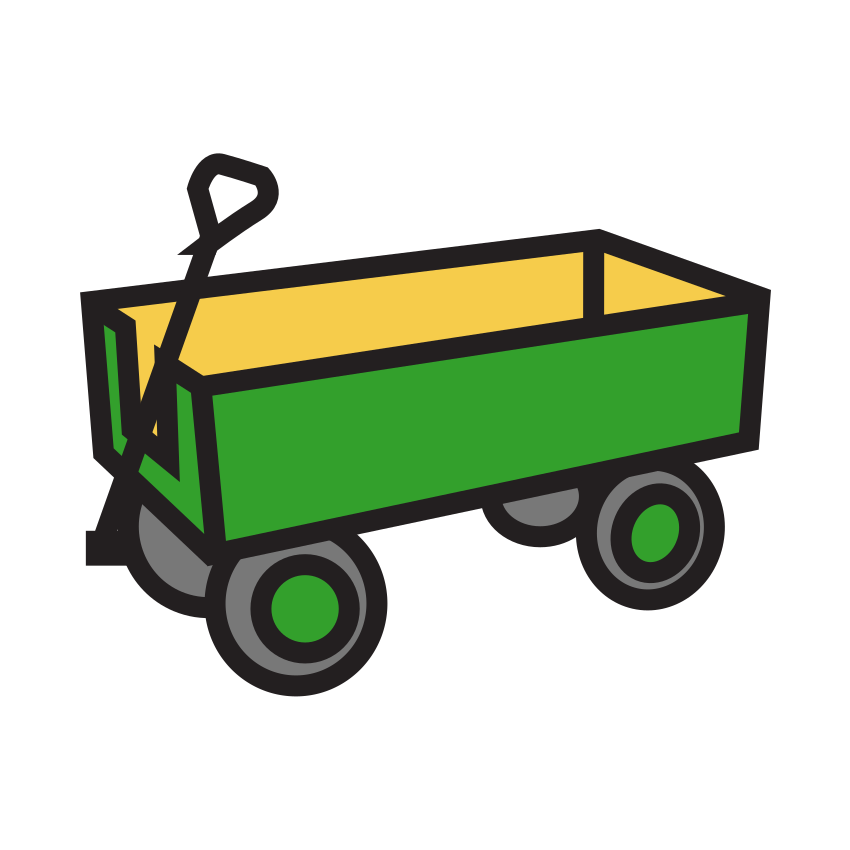
Split the word at the sound first: wa-gon, ti-ger. That turns a medial /g/ into a final one followed by an initial one, both of which are usually easier, and then you rejoin the halves. Bigger and buggy have doubled letters and are the clearest examples of the sound sitting right on the syllable break. Six minutes covers the twelve at word level.
Cueing ladder
Start at the top. Add support one step at a time.
- IndependentShow the card and wait 3 seconds for the student to say it.Log as correct
- Visual cuePoint to your mouth, or show the mouth picture for /g/, before the student tries again.Log as cued
- Verbal modelSay the word; the student says it right after you.Log as cued
- Placement cueTongue tip down behind your bottom teeth. Lift the back of your tongue to the back of the roof of your mouth, then release it with your voice on.Log as cued
Adjust it
Drop to syllables ('gah' and 'go'), or use fewer cards.
Put each word in a short carrier phrase with no /g/ in it or mix in /g/ words from another position.
Matching IEP goal
Given picture cards, Student will produce /g/ in the word-medial position in single words in 8 of 10 opportunities across 3 consecutive sessions, given no more than a visual cue.
Send it home through the parent portal →About this activity
Twelve words with /g/ in the middle: wagon, tiger, bigger, foggy, sugar, iguana, yogurt, seagull, wiggle, finger, magnet, buggy. Medial position is harder because the sound sits between two vowels with no boundary to lean on, and the tongue has to reach the back contact and leave it again inside a single word.
What to listen for
Listen for the sound weakening rather than being replaced. In the middle of a word, /g/ often arrives with insufficient contact and comes out as something closer to a vowel — wa-on instead of wagon. Watch iguana and seagull, which are the longest here and where the target is likely to be lost to the general difficulty of the word rather than to the sound itself.
Carrying it home
Tiger, sugar, finger and yogurt come up in ordinary days. Asking a family to listen for one word rather than a sound gives them a target they can actually track without turning every meal into practice.
What's in this activity
- wagon
- tiger
- bigger
- foggy
- sugar
- iguana
- yogurt
- seagull
- wiggle
- finger
- magnet
- buggy
Questions
- What grades is this for?
- Kindergarten through third, usually after initial /g/ is stable.
- Is it free?
- Yes, all twelve cards play with no account.
- Why is the middle of a word harder?
- Because there is no pause to reset. In initial position the tongue starts from rest; in the middle it has to arrive at the back contact and leave again while the word is still running.
Use this board with your caseload
With a free account, every correct, cued and incorrect mark is saved to the student and scored against their IEP goal, with the data written up for you. Assign it as home practice through the parent portal.
Track progress freeFree for SLPs. No card, no trial clock.