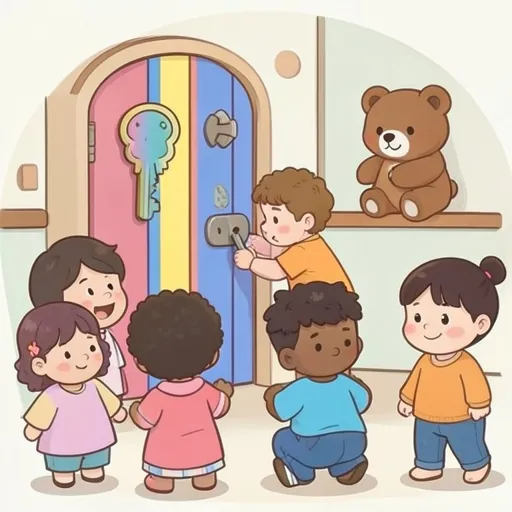
Escape the Toy Shop: Unlock Each Door
- Game
- K–2
- 10 pages · 10 min
An escape-room quiz for young students: ten doors, one puzzle each, from where the key is hidden to which toy fits the clue. Built for grades K–2, it works in pull-out, push-in, or teletherapy, with 10 screens, in about 10 minutes. Skill tags on this board: vocabulary, WH questions, verbal reasoning. Plays in the browser with no login; add students to score trials against IEP goals.
Quiz
Escape the Toy Shop: Unlock Each Door
Door 1. The key is under something you sleep on. Where is the key?
Tap your answer.
Session summary (SOAP)
Stays on this screen. Nothing is saved or sent.
Mark a card Correct, Correct with cue or Incorrect and the summary writes itself here.
How to run it
Tell the story as you go: 'We are locked in the toy shop. Let us read Door 1.' Read each door aloud, let the student answer, then say how the answer unlocks the door. Every answer moves on to the next door, so after a wrong one, go back to the clue together before you open the next.
Cueing ladder
Start at the top. Add support one step at a time.
- IndependentRead the door aloud and let the student answer; wait 5 seconds before helping.Log as correct
- Find the clue wordReread the clue and stress the key words, such as 'something you sleep on'.Log as cued
- Two choicesCover one wrong answer and ask the student to choose between the other two.Log as cued
- ModelSolve one door aloud, saying how the clue leads to the answer, then the student does the next.Log as cued
Adjust it
Act out or point to each clue in the room before the student answers.
Cover the choices and have the student answer each door in their own words first.
Matching IEP goal
Given a spoken clue, Student will answer who, what, where, why and how questions about it in 8 of 10 opportunities across 3 consecutive sessions.
Send it home through the parent portal →About this activity
An escape-room story told one door at a time. The student is locked in a toy shop after closing and each of the ten doors has one puzzle: where a key is hidden (under the bed), which toy fits a clue (a ball that bounces), an opposite (closed), or why you need a flashlight in the dark. The doors come in order, so the story moves forward with each answer, and the questions are tagged by WH type.
What to listen for
Notice which WH words are hardest: where questions here ask the student to turn a clue (something you sleep on) into a place (under the bed). A student who knows the word bed but picks the sink may be answering from one word in the clue rather than the whole sentence.
Carrying it home
Make a home escape game: hide a toy and write three clues, each leading to the next spot, like 'the next clue is under something you sit on'. Let your child read or hear each clue and find the next one.
What's in this activity
- Door 1. The key is under something you sleep on. Where is the key?
- under the bed
- under the sink
- in the oven
- Door 2. The lock opens for a toy that bounces. Which toy?
- a teddy bear
- a puzzle
- a ball
- Door 3. The note says to find something you read. What do you find?
- a sock
- a book
- a drum
- Door 4. The shop is dark. Why do you need a flashlight?
- to see
- to eat
- to sing
- Door 5. The robot needs a part that is round and rolls. Which part?
- a box
- a flag
- a wheel
- Door 6. The door opens when you say the opposite of open. What do you say?
- happy
- closed
- big
- Door 7. The next clue is with an animal that says quack. Where is it?
- with the duck
- with the cow
- with the cat
- Door 8. The puzzle box opens when it is not full. How is it?
- heavy
- wet
- empty
- Door 9. A sign says the last key is in the thing you wear on your head. Where is the key?
- in the mitten
- in the hat
- in the shoe
- Door 10. You are out! Who do you tell first that you escaped?
- the shopkeeper
- the toy robot
- the puzzle box
Questions
- Is it really a lock?
- Every answer opens the next door, right or wrong; the doors give the story an order and the data records which puzzles were solved.
- What skills are in it?
- Vocabulary, opposites and who, what, where, why and how questions, each told as part of one story.
Use this board with your caseload
With a free account, every correct, cued and incorrect mark is saved to the student and scored against their IEP goal, with the data written up for you. Assign it as home practice through the parent portal.
Track progress freeFree for SLPs. No card, no trial clock.