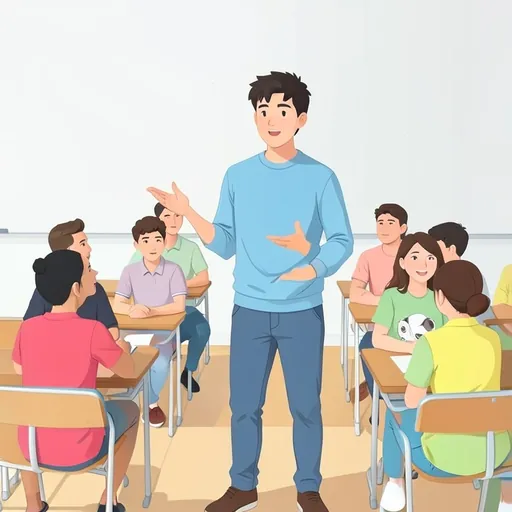
Easy Onset: Share One Idea With the Class
- Game
- 6–10
- 1 page · 10 min
Twelve class-share sentence starters that begin with a vowel or a gentle onset (I, our, a, another, I'll) so a student who stutters can practice easy onset in a real academic move: sharing an idea, adding a detail, asking a question, pointing to evidence, pausing to organize, and closing. Model a slightly easy first sound then have the student say the sentence as if they were in that class. After the sentence, they can add one real content word of their own. This is fluency practice in academic talk, not a babyish easy-onset list.
Talk about it
Easy Onset: Share One Idea With the Class
12 cards — tap to deal
How to run it
Deal one card at a time. The student looks at the picture and says the word or sentence on the card before you move on. You judge the production or the language form yourself; the cards advance either way. Work through the set once for a baseline, then return to the cards that were hard. Keep your own data: mark independent, cued, or modeled trials in your session notes. If the student is tired, do a shorter set rather than rushing the last cards.
Cueing ladder
Start at the top. Add support one step at a time.
- IndependentThe student starts the sentence with an easy onset, without being reminded. Wait 3 seconds.Log as correct
- Visual cueShow a gentle start with your hand, or a slightly longer first sound, before the next try.Log as cued
- Verbal modelSay the sentence with an easy onset; the student says it right after you.Log as cued
- Supported startSay the first word together with an easy start, then let the student finish the sentence.Log as cued
Adjust it
Practice the first word alone with an easy start, then add the rest of the sentence.
Use the same easy onset in a short unscripted comment about the picture.
Matching IEP goal
Given pictured sentence cards, Student will use an easy onset on the first word of a sentence in 8 of 10 opportunities across 3 consecutive sessions, given no more than a visual cue.
Send it home through the parent portal →About this activity
Easy Onset: Share One Idea With the Class is a English speaking cards board for middle and high school students. Twelve class-share sentence starters that begin with a vowel or a gentle onset (I, our, a, another, I'll) so a student who stutters can practice easy onset in a real academic move: sharing an idea, adding a detail, asking a question, pointing to evidence, pausing to organize, and closing. Model a slightly easy first sound then have the student say the sentence as if they were in that class. After the sentence, they can add one real content word of their own. This is fluency practice in academic talk, not a babyish easy-onset list.
What to listen for
Listen and watch for the skill named in the description, not only whether the student finishes the board. Notice whether errors cluster on certain items (for example I want to share one idea from the article.) or show up across the set. For pictured items, confirm the student is talking about the picture you meant. If a listening item is missed, replay it once before you show the words. Write down the cue level that made the next try successful so you can fade it next session.
Carrying it home
Pick three items from the board and use them in a real routine at home or in class the same day. An adult can show the picture, wait, and then model the word or sentence if needed. Keep practice short and specific: one or two minutes on I want to share one idea from the article. is enough. If you send the link home, tell families the board is a practice tool, not a test, and that the SLP will interpret the responses.
What's in this activity
- I want to share one idea from the article.
- Our group found one example in the data.
- I agree with that point and I can add one detail.
- A question I still have is about the last step.
- I used an outline so my points stay in order.
- Our evidence is in the second paragraph.
- I can explain it in a shorter way.
- Another angle is what happens after the experiment.
- I need a minute to organize my thought.
- Our conclusion is only as strong as the source.
- I appreciate the question and here's what I meant.
- I'll end with one thing we can try next.
Questions
- Who is this for?
- This board is for middle and high school students working on the skills in the description, including I want to share one idea from the article, Our group found one example in the data, I agree with that point and I can add one detail, A question I still have is about the last step, I used an outline so my points stay in order, and Our evidence is in the second paragraph.
- Is it free?
- Yes. It plays free in the browser with no login. An account adds session data, goal scoring, and assignment to a student.
- Can I change the items?
- Yes. Copy the activity to your library or rebuild the list in Activity Studio with the same template. Keep the same target and grade band so the pictures and wording still fit.
Use this board with your caseload
With a free account, every correct, cued and incorrect mark is saved to the student and scored against their IEP goal, with the data written up for you. Assign it as home practice through the parent portal.
Track progress freeFree for SLPs. No card, no trial clock.